Speck Chrysler Jeep Dodge Ram

Blog / Automotive Financing

What Happens at the End of a Car Lease? Your Financing Options

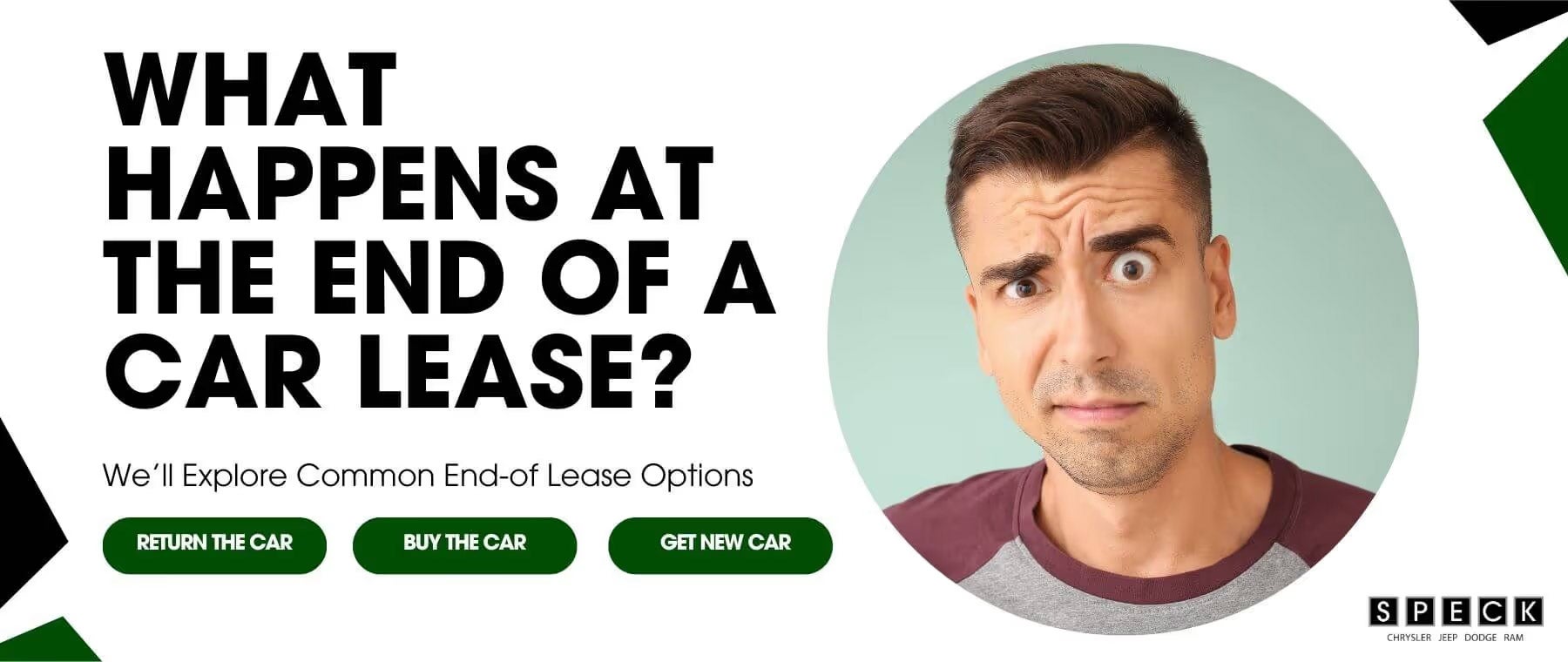
What Happens at the End of a Car Lease

Common End-of-Lease Options

When your lease is up, you typically have three main choices:

  • Return the Car and Walk Away: If you don’t want to keep the vehicle, you can return it to the dealership. Be sure to account for any excess mileage, wear and tear, or lease-end fees.
  • Buy the Car: Many lease agreements include a buyout option, allowing you to purchase the vehicle for a predetermined amount.
  • Lease or Buy Another Vehicle: You can transition into a new lease or finance a different vehicle, often loyalty incentives from the dealer.

Should You Buy Your Leased Vehicle?

Buying your leased car can be a smart move under certain circumstances:

  • The Buyout Price Is Less Than Market Value: If the car’s residual value is lower than its current market price, purchasing it could save you money.
  • You Love the Vehicle: If you’ve taken good care of the car and it fits your needs, buying it eliminates the hassle of searching for a new one.
  • Avoid Lease-End fees: Purchasing your vehicle may be a good option if you’re facing high wear-and-tear penalties or excess mileage charges.

Lease-End Fees to Watch Out For:

Before returning your leased vehicle, review potential charges:

  • Excess Mileage Fees: Leases come with mileage limits, and exceeding them can result in costly per-mile charges.
  • Wear and Tear Charges: Any damage beyond normal use may incur repair costs.
  • Disposition Fees: Some lease agreement include a fee for returning the vehicle, typically covering resale preparation costs.

Financing Your Lease Buyout

If you decide to purchase your leased vehicle, you’ll need financing unless you plan to pay in cash. Options include:

  • Bank or Credit Union Loans: Comparing rates with outside lenders can help secure the best terms.
  • Personal Savings or Trade-In Value: Using cash or trading in another vehicle can help lower the amount you need to finance.

Explore Available Options

As your lease term nears its end, explore all available options to determine the best financial move. Whether you return, buy, or lease a new vehicle, understanding the costs and benefits will ensure a smooth transition to your next car.

The information provided is for general informational purposes only and does not constitute legal, financial, or professional advice. While we strive to provide accurate and up-to-date information, we make no guarantees regarding the completeness, accuracy, or reliability of the information presented. Any action you take based on the context of this blog is strictly at your own risk. Always consult a qualified professional or specialist for advice specific to your situation. We are not responsible for any losses or damages arising from the use of this blog or its content.

Posted in:

Related Posts

Can I Use My ITIN to Get a Car Loan?

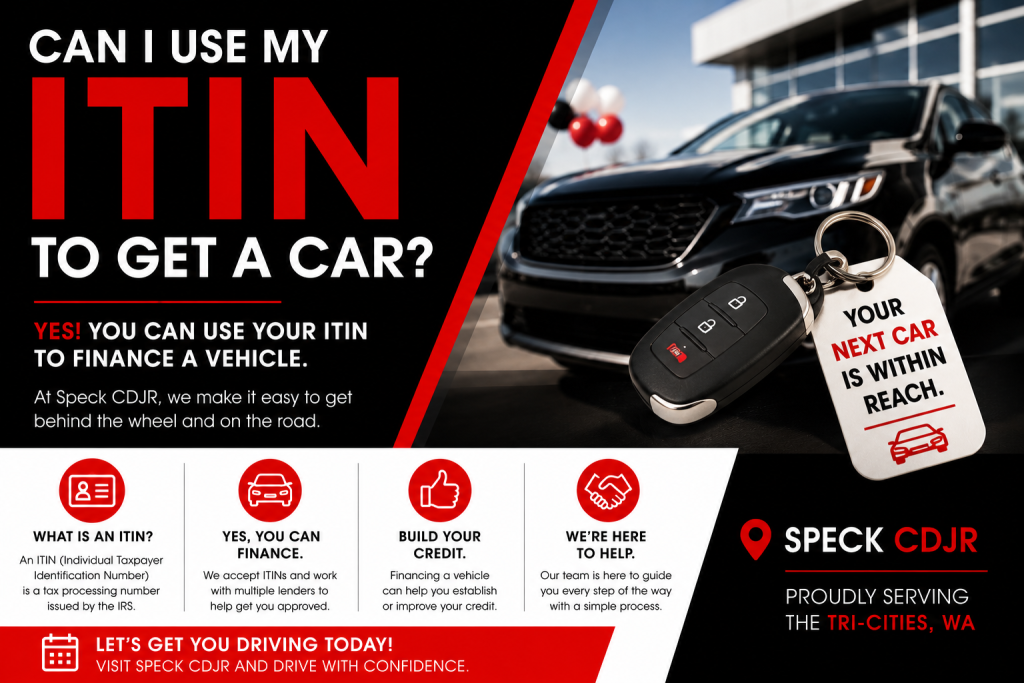
If you've been wondering whether you can use your ITIN to get a car loan — the answer is yes. ITIN car loan and vehicle financing options are more accessible than most people realize — and at Speck CDJR, we work with buyers from all walks of life and are proud to help customers across the Yakima Valley get into a quality vehicle regardless of credit history or documentation status. If you've been wondering whether you can use your ITIN to get a car loan — the answer is yes. At Speck CDJR, we work with buyers from all walks of life and are proud to help customers across the Yakima Valley get into a quality vehicle regardless of credit history or documentation status. What Is an ITIN? An ITIN — or Individual Taxpayer Identification Number — is a tax processing number issued by the IRS to individuals who need a U.S. taxpayer identification number but are not eligible for a Social Security Number. It is used exclusively for tax purposes, but it can be used for vehicle financing in many situations. Can I Use My ITIN to Get a Car Loan? Yes, many lenders accept an ITIN in place of a Social Security Number for car loan applications. Our finance team at Speck CDJR works with a wide network of lenders who specialize in ITIN vehicle financing, including both new car loans and used car loans. What If I Have No Credit History? A no credit car loan is possible, especially with Speck CDJR's lender network. Here's what strengthens your application: Larger Down Payment: Reduces lender risk and improves approval chances Proof of Stable Income: Consistent, verifiable income is one of the strongest approval factors Co-Signer: A co-signer with U.S. credit can open additional financing options Longer Employment History: Consistent employment with the same employer helps significantly New Car Loan vs. Used Car Loan A new car loan gives you the latest models, full factory warranty, and available manufacturer incentives — typically with lower interest rates. A used car loan offers lower monthly payments and is often the more accessible option for first-time or credit-challenged buyers. Every used vehicle at Speck CDJR includes a free CARFAX report for full transparency. What Documents Do I Need? Bring the following when you come in: ITIN card or IRS documentation Valid government-issued photo ID Proof of income like pay stubs or bank statements Proof of residence, such as a utility bill or lease agreement Down payment of cash, check, or trade-in Why Finance With Speck CDJR? Wide Lender Network: Lenders who specialize in ITIN and non-traditional financing Bilingual Team: Spanish-speaking team members available to assist you No Judgment, No Pressure: Every customer deserves a fair shot at reliable transportation CARFAX on Every Used Vehicle: Full transparency on every pre-owned vehicle we sell Ready to Apply? Come See Us. Whether you need a new car loan, used car loan, or no credit car loan using your ITIN, our finance team at Speck CDJR is here to help. Come in, bring your documents, and let us find the right solution for you. We serve the entire Yakima Valley and Tri-Cities area and are committed to helping every customer drive away happy. Apply for Finance The information provided is for general informational purposes only and does not constitute legal, financial, or professional advice. While we strive to provide accurate and up-to-date information, we make no guarantees regarding the completeness, accuracy, or reliability of the information presented. Any action you take based on the context of this blog is strictly at your own risk. Always consult a qualified professional or specialist for advice specific to your situation. We are not responsible for any losses or damages arising from the use of this blog or its content.

Down on a Car Loan

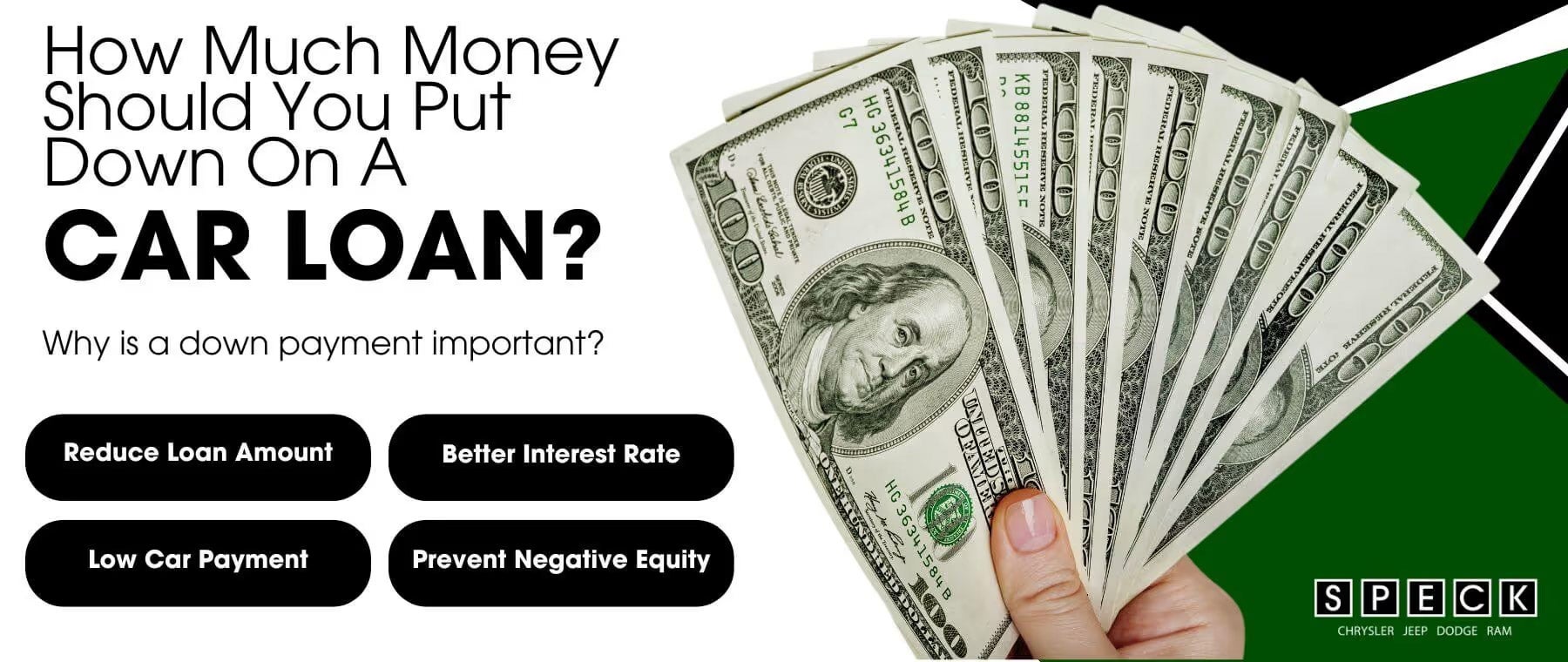
How Much Should You Put Down on a Car Loan

Buying a car is significant financial commitment, and determining how much to put down on a car loan is an important decision. A down payment can affect your monthly payments, interest rates, and overall loan terms. Here’s what you need to know about making a down payment on a car loan. Why Is a Down Payment Important? A down payment serves several key purposes: Reduces Your Loan Amount: The more you put down, the less you have to borrow. Lowers Monthly Payments: A smaller loan means lower monthly payments. May Help Secure Better Interest Rates: Lenders may offer better terms to borrowers who provide a substantial down payment. Prevents Negative Equity: A good down payment helps offset depreciation, reducing the risk of owing more than the car’s value. How Much Should You Put Down? The ideal down payment depends on several factors, including your credit score, loan terms, and the cost of the vehicle. Here are general guidelines: New Cars: Aim for 20% of the car’s purchase price to cover depreciation and secure favorable loan terms. Used Cars: A 10% down payment is typically recommended since used cars depreciate at a slower rate. Bad Credit Buyers: Those with lower credit scores may need a higher down payment, around 10-20%, to improve loan approval chances. What If You Can’t Afford a Large Down Payment? If a 20% down payment isn’t feasible, there are alternatives: Trade-In Your Vehicle: Using a trade-in can reduce the amount you need to put down. Look for Manufacturer or Dealer Incentives: Some dealerships offer special promotions that reduce down payment requirements. Save Up Before Purchasing: If possible, delay your purchase to build savings for a larger down payment. Consider Gap Insurance: If your down payment is small, gap insurance can protect against depreciation losses in case of an accident. Should You Put More Than the Minimum? If you have the financial flexibility, a larger down payment can be beneficial: Less Interest Paid Over Time: A smaller loan balance accrues less interest. Shorter Loan Terms: You may be able to afford a shorter loan, reducing the total cost of borrowing. Improved Loan Approval Chances: A larger down payment can make financing easier, especially for those with lower credit scores. Conclusion While the recommended down payment for a car loan varies, aiming for 10-20% can help reduce financial strain and secure better loan terms. Consider your budget, credit score, and available incentives to determine the right amount for your situation. Shop Inventory Apply for Financing Payment Calculator The information provided is for general informational purposes only and does not constitute legal, financial, or professional advice. While we strive to provide accurate and up-to-date information, we make no guarantees regarding the completeness, accuracy, or reliability of the information presented. Any action you take based on the context of this blog is strictly at your own risk. Always consult a qualified professional or specialist for advice specific to your situation. We are not responsible for any losses or damages arising from the use of this blog or its content.

What Is the Best New Jeep for My Family?

Finding the right family SUV is one of the most important vehicle decisions you will make. Jeep offers a wide range of capable, comfortable, and well-equipped SUVs for families of every size. Whether you need seating for five or seven, there is a Jeep SUV built for your family's lifestyle. Here is a breakdown of the best new Jeeps for families available at Speck CDJR in Sunnyside. What Makes a Jeep Great for Families? Jeep SUVs are built to handle everything families throw at them. They offer strong safety ratings, advanced driver-assist technology, and spacious interiors. Available AWD and 4x4 systems make them a great choice for Eastern Washington winters and varied terrain. Jeep also offers some of the most recognizable and trusted nameplates in the SUV segment today. Here is a look at the best Jeeps for sale for families right now. Jeep Compass Best for Small Families Starting From $28,000 MSRP Seats 5 The Jeep Compass is the most affordable Jeep SUV for families in the lineup. It is a great choice for small families and first-time buyers who want Jeep capability at an accessible price. The Compass comes standard with Jeep's active safety suite and available AWD for all-weather confidence. It also offers a comfortable and well-equipped interior that punches above its price point. Key Benefits: Available AWD for Eastern Washington winters and varied terrain Standard forward collision warning and automatic emergency braking Available 10.1-inch Uconnect 5 touchscreen with wireless Apple CarPlay Comfortable and spacious interior for a compact SUV Most affordable Jeep for sale in the entire Jeep lineup Best for: Small families, couples, and first-time buyers who want a capable and affordable Jeep SUV. Jeep Cherokee Best for Growing Families Starting From $32,000 MSRP Seats 5 The Jeep Cherokee steps up in size and capability over the Compass. It offers a more spacious interior and a wider range of available features and packages. The Cherokee is a great family SUV for growing households who need more room without stepping up to a full-size three-row SUV. Available Trailhawk trim adds serious off-road capability for Eastern Washington adventure seekers. Key Benefits: More spacious interior than the Compass for growing families Available Trailhawk trim with enhanced off-road capability Available 4x4 system for serious all-terrain confidence Available heated front and rear seats for Eastern Washington winters Strong safety ratings and comprehensive driver-assist technology Best for: Growing families who need more room and capability than the Compass but are not ready for a three-row SUV. Jeep Grand Cherokee Best for Premium Family Comfort Starting From $40,000 MSRP Seats 5 to 7 The Jeep Grand Cherokee is the most popular and well-rounded Jeep SUV for families today. It offers a premium interior, serious off-road capability, and available three-row seating in the Grand Cherokee L configuration. The Grand Cherokee consistently earns top safety ratings and is one of the most feature-rich family SUVs available at its price point. Key Benefits: Available Grand Cherokee L with three-row seating for up to seven passengers Available 4xe plug-in hybrid powertrain for improved fuel efficiency Standard Jeep Active Safety Group with automatic emergency braking Available Quadra-Lift air suspension for adjustable ride height Premium interior with available leather seating and McEvoy wood trim One of the highest-rated family SUVs in its class for safety and comfort Best for: Families who want a premium, well-equipped Jeep SUV with available three-row seating and serious off-road capability. Jeep Wagoneer Best for Large Families Starting From $60,000 MSRP Seats 8 The Jeep Wagoneer is the full-size three-row Jeep SUV built for larger families. It offers seating for up to eight passengers across three rows. The Wagoneer also delivers up to 10,000 lbs of towing capacity for families who need to pull a boat, camper, or trailer. It is a genuine luxury SUV at a price point that significantly undercuts European competitors. Key Benefits: Three-row seating for up to eight passengers Up to 10,000 lbs of towing capacity for boats and campers Available 4x4 system for all-terrain and winter driving confidence McIntosh premium audio system available for an exceptional in-cabin experience Available rear-seat entertainment system to keep kids entertained on long drives Standard Amazon Fire TV Built-In on higher trims Best for: Larger families who need maximum seating, serious towing capability, and a premium three-row SUV experience. Quick Family Jeep Comparison Jeep Model Starting MSRP Seating Best For Compass $28,000 5 Small families and first-time buyers Cherokee $32,000 5 Growing families needing more room Grand Cherokee $40,000 5 to 7 Premium comfort and three-row option Wagoneer $60,000 8 Large families needing maximum space All MSRPs are approximate starting prices and exclude destination charge, taxes, title, and license fees. Contact Speck CDJR for exact in-stock pricing and current Jeep offers. Which Jeep Is Right for Your Family? Every family is different. The right Jeep SUV depends on your family size, lifestyle, and budget. Here is a quick guide to help you decide: Choose the Compass if you have a small family and want an affordable and capable entry-level Jeep SUV. Choose the Cherokee if your family is growing and you need more room without stepping up to a three-row SUV. Choose the Grand Cherokee if you want a premium family SUV with available three-row seating and serious capability. Choose the Wagoneer if you have a large family and need maximum seating, towing capability, and a luxury experience. At Speck CDJR in Sunnyside, we have a wide selection of new Jeeps for sale across every model and trim level. Our team is ready to help you find the perfect family SUV for your household. Stop by or browse our current Jeep inventory online today. Your perfect family Jeep is waiting for you at Speck CDJR. Jeep SUV's The information provided is for general informational purposes only and does not constitute legal, financial, or professional advice. While we strive to provide accurate and up-to-date information, we make no guarantees regarding the completeness, accuracy, or reliability of the information presented. Any action you take based on the context of this blog is strictly at your own risk. Always consult a qualified professional or specialist for advice specific to your situation. We are not responsible for any losses or damages arising from the use of this blog or its content.